
Written by Michael Erike, Business Attorney in Scottsdale, Arizona
With Arizona job growth slowing to just 0.3% and federal economic policy uncertainty creating business headwinds, Arizona business owners are facing tighter margins and increased pressure to protect their interests through ironclad contracts.
The Arizona Limited Liability Company Act (ALLCA) and recent updates to commercial contracting standards mean that assumptions you made even two years ago about business contracts may no longer hold true in Arizona.
Here’s what changed and why it matters to your business.
How the Arizona Limited Liability Company Act Changed Default Provisions
The ALLCA introduced significant changes to how Arizona treats LLC operating agreements and member disputes. Many business owners formed their LLCs years ago and haven’t revisited their foundational documents since.
Key changes affecting your business:
- Default provisions now apply differently to multi-member versus single-member LLCs
- Member voting rights and profit distribution rules have new statutory defaults
- Fiduciary duty standards for LLC managers have been clarified and, in some cases, expanded
If your operating agreement doesn’t explicitly address these issues, Arizona law will fill in the gaps for you. Those statutory defaults may not align with your actual business arrangements or intentions. The result? Confusion, disputes, and potential litigation when partners disagree about decision-making authority or profit splits.
What silently changed in your contracts:
Your existing contracts may reference outdated LLC statutes or assume certain default rules that no longer exist. Partnership agreements, buy-sell agreements, and vendor contracts that interact with your LLC structure need review to ensure they still function as intended under current law.
What Business Owners Need to Know About Uniform Commercial Code Compliance
Arizona’s adoption of updated Uniform Commercial Code provisions has altered how purchase agreements and sales contracts are interpreted. These changes particularly affect businesses that buy or sell goods as part of their operations.
UCC compliance now requires attention to:
- Electronic contracting and digital signature validity standards
- Modified rules for contract formation in commercial transactions
- Updated provisions regarding security interests in personal property
- Changes to remedies available when contracts are breached
Many business disputes arise not from subtle misalignments between what parties thought they agreed to and what the law says their contract actually means. UCC compliance in purchase agreements has become more technical, and informal arrangements that might have been enforceable in the past may not hold up today. The devil, as they say, is in the details.
Your contracts may be outdated without you knowing it. An attorney can help you review your agreements.
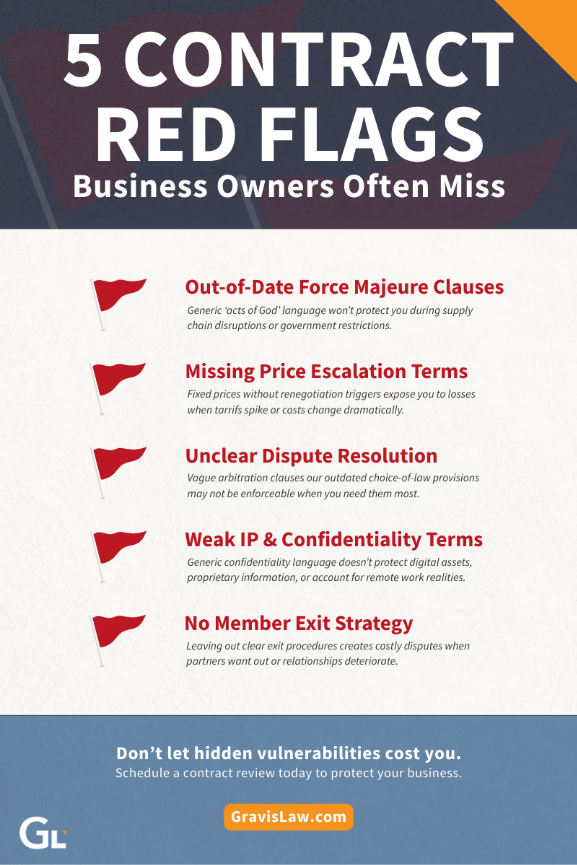
Common Contract Vulnerabilities Arizona Businesses Face in 2026
Even well-drafted contracts from just a few years ago may now contain problematic provisions or miss critical protections. As someone who spends equal time reviewing movie production contracts and business agreements, I’ve learned that clarity prevents conflict. Here’s what creates vulnerability:
Force majeure clauses: Post-pandemic, courts scrutinize these clauses more carefully. Generic language about “acts of God” may not protect you during supply chain disruptions, government restrictions, or economic downturns.
Payment and pricing terms: With tariffs affecting costs unpredictably, fixed-price contracts without escalation clauses or renegotiation triggers expose you to losses. Your contract should address who bears the risk when costs change dramatically. This isn’t just theoretical. As a filmmaker, I’ve watched production budgets balloon when equipment rental costs spiked unexpectedly, and the same principle applies to every Arizona business dealing with volatile supplier pricing.
Dispute resolution provisions: Arizona courts have issued recent guidance on arbitration agreements and choice-of-law provisions. Clauses that seemed straightforward may now be unenforceable or may not provide the protection you expected.
Intellectual property and confidentiality: As businesses increasingly rely on digital assets and proprietary information, contracts need explicit IP ownership provisions and up-to-date confidentiality terms that account for remote work and electronic information sharing. In creative industries, we’re hyper-aware that IP is everything. Your business likely has equally valuable proprietary information that deserves the same level of protection.
How Outdated Operating Agreements Create Partnership Disputes
One of the most overlooked vulnerabilities involves the operating agreement itself. Reviewing and updating the operating agreement is often overlooked, yet it governs everything about how your business operates.
I’ve seen partnerships dissolve because the operating agreement didn’t address what happens when creative or business visions diverge. The time to establish those ground rules isn’t when relationships are strained. It’s day one.
Operating agreements become problematic when:
- They don’t address what happens if a member wants to exit the business
- Profit distribution methods no longer reflect current ownership percentages or contribution levels
- Decision-making authority is unclear, especially for major business decisions
- Dispute resolution processes aren’t defined, forcing costly litigation
- They fail to address modern issues like remote work, digital assets, or cryptocurrency transactions
In Scottsdale, Arizona, where many businesses operate as closely held LLCs with just two or three members, these gaps create serious problems. When relationships deteriorate or unexpected situations arise, an outdated operating agreement provides no roadmap for resolution. It’s the business equivalent of shooting a film without a script. You might get lucky, but you’re far more likely to end up with an expensive mess.
Protect Your Business Before Problems Arise
The economic pressures facing Arizona businesses make contract clarity more important than ever. You can’t afford ambiguity when margins are tight and disputes are costly.
Reviewing your contracts isn’t about expecting problems. It’s about preventing them. Just like storyboarding prevents chaos on set, comprehensive contract review prevents business disasters down the line.
A comprehensive contract review examines:
- Whether your agreements comply with current Arizona law
- If default provisions work in your favor or against your interests
- Whether your contracts protect you adequately in changed economic circumstances
- How dispute resolution provisions would actually function if needed
Business litigation often traces back to contracts that seemed fine when signed but contained hidden vulnerabilities that emerged under stress. The time to identify and fix those weaknesses is now, before they cost you.
Protect Your Business Before Problems Arise
Arizona’s business environment is changing. Economic uncertainty, evolving legal standards, and increased commercial disputes mean your contracts need to work harder than ever. Don’t assume agreements drafted two, three, or five years ago still provide the protection you need.
Reach out to us today to schedule a consultation about strengthening your contracts and ensuring your business is protected under current Arizona law.
About the Author
Michael Erike is a business attorney at Gravis Law who approaches contracts the way a filmmaker approaches a script: every element must serve the story, and details matter. Michael has built his practice around helping entrepreneurs and families navigate complex business transitions, partnership disputes, and estate planning matters.
Clients describe him as both their attorney and therapist, someone who listens without judgment, and brings calm clarity to overwhelming situations. Outside the office, Michael is an active filmmaker and writer-producer who, alongside his brother (and directing partner), Jaric, creates films throughout the Valley and champions Arizona’s growing creative community.
This article is for informational purposes only and is not legal advice. Your circumstances are unique, and an attorney can provide guidance that fits your needs.
This article is for informational purposes only and does not constitute legal advice.
Download our guides for expert insights to plan your estate, navigate family law, or secure your future. Simplify the process with clear, actionable steps. Get started today!