
Written by Dalton Cannon, Washington Bankruptcy Attorney
If you’re considering filing bankruptcy in Washington, one of the most common questions is: what happens to my tax refund? When you file Chapter 7 bankruptcy the answer depends on how much you expect to receive, when your case is filed, and what exemptions you can claim to protect it.
Understanding how the bankruptcy trustee treats your tax refund can help you make strategic decisions about timing and protect as much of your money as possible.
Does the Bankruptcy Trustee Take Your Tax Refund?
The short answer is maybe. When you file Chapter 7 bankruptcy, your tax refund is considered part of your bankruptcy estate, treated almost identically to dollars that are already in your bank account – even if you haven’t received it yet. That means the trustee has a claim to it to pay your creditors. However, state and federal law offer exemptions that can allow you to protect a portion, or all, of your refund – depending on a few factors.
A key factor is timing. If you’ve already filed your taxes and received your refund before filing bankruptcy, that money is co-mingled with your other finances, and subject to the trustee’s claim unless appropriately exempted. If you file bankruptcy before receiving your refund, the trustee can still claim any unexempt portion of the refund you earned before your filing date.
How the Trustee Calculates Your Refund During a Tax Year
Often, a bankruptcy case is not filed between January 1st and April 15th – there 8 other months in the year – and so there isn’t a full tax year and potential refund to consider. The bankruptcy trustee tax can calculate a refund on a pro-rata basis. If you file bankruptcy in June, the trustee is entitled to the portion of your refund that represents income earned from January through June. The remaining portion, representing July through December, belongs to you.
For example, if you’re expecting a $3,600 annual refund and file bankruptcy in June, the trustee could claim approximately $1,800 (six months’ worth), and you’d keep the remaining $1,800 without needing to utilize an exemption. This calculation applies to both federal and state tax refunds.
When a filing occurs within the first 4 months of a year, a bankruptcy trustee will often not concern themselves with the pro-rata and hypothetical tax refund of the current year, and instead focus on the known, expected, refund from the previous year, if not yet received.
Can You Keep Your Tax Refund in Chapter 7 Bankruptcy?
Yes, you can potentially keep your tax refund in bankruptcy by using Washington’s exemption laws. Washington allows you to choose between state exemptions and federal bankruptcy exemptions, and the right choice depends on your specific situation.
Under Washington state exemptions, you can protect up to a certain amount of cash and personal property. If your tax refund falls within these limits and you haven’t used all your available exemptions on other assets, you may be able to keep your entire refund. Working with a bankruptcy attorney in Washington helps you maximize your exemptions and keep your money in your pocket.
Strategic Timing Matters
The timing of your bankruptcy filing can significantly impact how much of your tax refund you keep. Some people choose to file bankruptcy early in the year before any of their refund is received; this can make it more difficult to protect but can ensure that you keep your entire refund when later received. Filing before their refund is received also takes advantage of the tax filing deadline in April. Others wait until after receiving and spending their refund on necessary expenses like car repairs, medical bills, or other essentials so they don’t need to use their exemptions to protect the refund (though this requires careful documentation and planning to avoid preferential transfer issues).
Both cases are useful under the right set of circumstances, and opening a dialogue early with an experienced attorney can ensure proper pre-bankruptcy planning to maximize protections.
Worried about losing your tax refund to bankruptcy?
What Happens to Tax Refunds for Married Couples Filing Bankruptcy?
If you’re married and only one spouse is filing Chapter 7 bankruptcy, the situation becomes more complex and will vary widely state-to-state. In Washington, the bankruptcy trustee can still claim the non-filing spouse’s portion of a joint tax refund together with the filing spouse’s, due to community-property laws. The complex interplay of community-property laws and bankruptcy exemptions can cause significant loss of assets, and consulting an attorney is highly recommended.
Keep in mind: except for some extreme cases, the trustee has a right to consider any assets of the marital community, even if one spouse isn’t actively participating in the bankruptcy filing.
How to Protect Your Tax Refund in Chapter 7
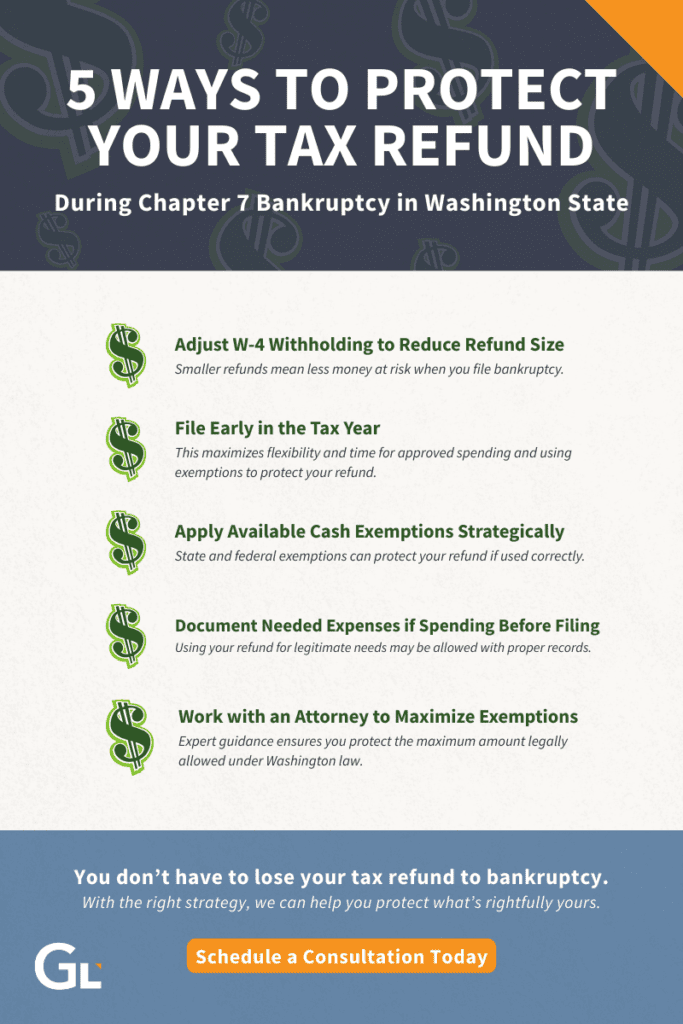
There are several strategies to protect your tax refund when filing Chapter 7 bankruptcy:
- Adjust your withholding: If you typically receive large refunds, consider adjusting your W-4 to reduce withholding and increase your take-home pay throughout the year instead of getting a big refund.
- Time your filing strategically: There are pros and cons to filing your taxes before filing bankruptcy, however, discussing your options with an attorney is always a good strategy. For most people, filing your taxes as early as possible maximizes your flexibility and options for using and protecting your tax refund.
- Use exemptions wisely: Work with your attorney to apply available exemptions to protect your refund.
- Spend on necessities before filing: If you’ve already received your refund, using it for legitimate necessary expenses before filing (with proper documentation) may be an option, though this requires careful legal guidance.
The key is transparency. Never hide assets or tax refunds from the bankruptcy trustee. Attempting to conceal income or assets is bankruptcy fraud and can result in your case being dismissed or criminal charges.
Don’t Navigate This Alone
Understanding what happens to your tax refund when you file Chapter 7 bankruptcy requires careful analysis of your specific situation, timing, and available exemptions. The difference between keeping your refund and losing it to the trustee often comes down to strategic planning and proper use of state and federal exemption laws.
Whether you’re in Richland or elsewhere in Washington, including Tacoma, Spokane, Olympia, Seattle, or Dayton, getting experienced legal guidance can help you protect your assets and achieve the fresh financial start bankruptcy offers. Don’t leave money on the table or make costly timing mistakes.
Reach out to us today to schedule a consultation and learn exactly how to protect your tax refund while successfully navigating the Chapter 7 bankruptcy process.
About the Author
Dalton Cannon is an Associate Attorney in Richland, Washington, who is conversational in Spanish and passionate about helping people overcome financial challenges and get back on their feet. Raised in Benton City and one of Gravis Law’s first employees, Dalton has worked his way through every level of the firm, giving him a comprehensive understanding of how to navigate complex bankruptcy cases from start to finish.
He knows that financial stress can shift from manageable to overwhelming in an instant, and he brings that same ability to assess and triage problems to help clients protect their assets and achieve the fresh start that Chapter 7 bankruptcy offers.
Dalton’s goal is simple: remove the barriers standing between you and financial success so you can move forward with confidence.
This article is for informational purposes only and is not legal advice. Your circumstances are unique, and an attorney can provide guidance that fits your needs.
This article is for informational purposes only and does not constitute legal advice.
Download our guides for expert insights to plan your estate, navigate family law, or secure your future. Simplify the process with clear, actionable steps. Get started today!