
Written by Disability Attorney Jason Jenkins
If you or a family member has a disability, an ABLE Account could be one of the most useful financial tools you have never heard of. Understanding ABLE account eligibility requirements is the first step toward protecting savings without risking the benefits your family depends on.
Here is what you need to know and why having an attorney in your corner matters when you put these tools to work.
What Is an ABLE Account, Really?
An ABLE account (Achieving a Better Life Experience) is a tax-advantaged savings account designed specifically for people with qualifying disabilities. Think of it as a 529 college savings plan, but for disability-related expenses instead of tuition.
Here is how it works at a basic level:
- Contributions grow tax-free
- Withdrawals used for qualified disability expenses are not taxed
- Up to $100,000 in the account is excluded from SSI’s $2,000 countable asset limit
- Balances below the state plan limit do not affect Medicaid, SNAP, HUD, FAFSA, SSDI, or Medicare eligibility
The ABLE Act (also called 529A) created these accounts to give people with disabilities a realistic way to save money without losing access to critical needs-based benefits. Before ABLE accounts existed, saving even a modest amount could disqualify someone from SSI entirely.
ABLE Account Eligibility Requirements: Do You Qualify?
This is where families often have questions. Not everyone with a disability qualifies, so it is worth understanding the criteria before you get too far into planning.
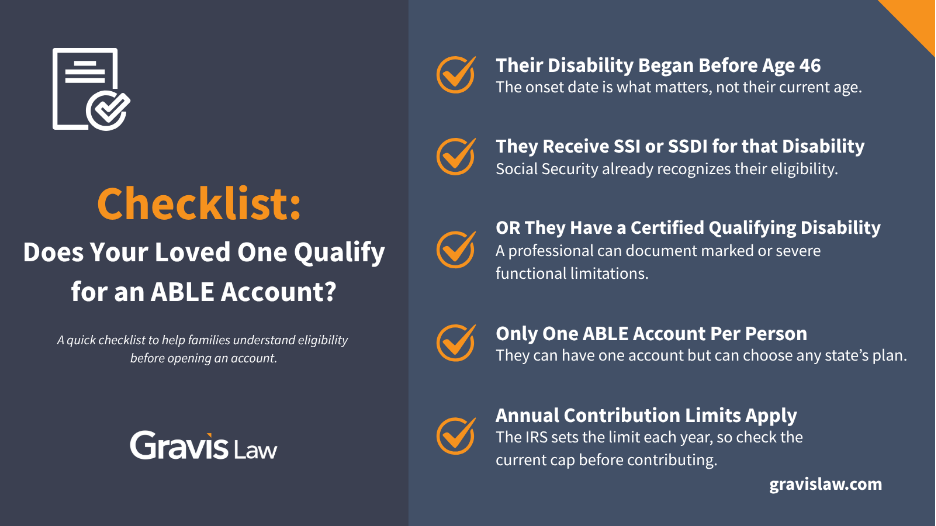
To open an ABLE account, you must meet all of the following:
- Your disability began before age 46 (this age limit was expanded from 26 under the ABLE Age Adjustment Act)
- You are currently receiving SSI or SSDI based on that disability, OR
- You have a disability certification from your physician showing that your disability meets Social Security’s definition of “marked and severe functional limitations”
A few things worth noting:
- You do not have to be receiving government benefits to qualify, but you do need documentation of your disability
- Each person can only have one ABLE account
- Annual contribution limits apply (set by the IRS each year)
The basics here are navigable, but the details matter. An attorney familiar with special needs planning can help you confirm eligibility and make sure the account is set up in a way that protects your benefits rather than accidentally jeopardizing them.
An ABLE account lets people with disabilities save money and spend it on everyday needs without losing access to SSI, Medicaid, or other critical benefits.
Your planning decisions deserve a second set of eyes.
What Are ABLE Act Qualified Disability Expenses?
One of the most common questions after “do I qualify” is “what can I actually use the money for?” The list of ABLE Act qualified disability expenses is broader than most people expect.
Funds can be used for:
- Housing and utilities
- Transportation
- Education and job training
- Employment support
- Health and wellness expenses
- Assistive technology
- Legal fees
- Financial management
- Basic living expenses
The key is that the expense must relate to the account holder’s disability and help maintain or improve their health, independence, or quality of life. Withdrawals used for non-qualified expenses are taxable and may carry a penalty, which is another reason to work through these decisions with professional guidance rather than going it alone.
ABLE Account Disability Savings vs. a Special Needs Trust: What Is the Difference?
ABLE accounts are powerful, but they are not the only tool available, nor are they always the right fit on their own. Families often use them alongside a special needs trust rather than instead of one.
Here is a quick comparison:
- ABLE accounts are simpler to open and manage, but have annual contribution limits and are owned by the person with the disability
- Special needs trusts can hold unlimited assets, can receive inheritances or legal settlements, and are managed by a trustee on the beneficiary’s behalf
- ABLE accounts are ideal for day-to-day qualified expenses; trusts are better suited for larger asset protection and long-term planning
If you are also navigating what happens when your special needs child turns 18 and SSI benefits are at risk, these two tools often work together as part of a broader strategy.
Tax-Free Savings Account for Disabled Adults: Why This Matters Beyond the Numbers
The financial mechanics are important, but the bigger picture is what ABLE account disability savings actually makes possible: stability, independence, and the ability to plan ahead without fear of losing a benefit overnight.
For adults with disabilities who want to work, save, and build a life, the asset limits tied to SSI have historically made that feel impossible. ABLE accounts change that dynamic in a meaningful way.
Some things families often do not realize:
- A person with a disability can contribute their own earned income to an ABLE account above the standard annual limit under the ABLE to Work Act
- Some states offer their own ABLE programs with additional perks, though you can typically enroll in any state’s plan regardless of where you live
- ABLE accounts can also be invested, not just held as cash, which allows the balance to grow over time
That said, the rules around contributions, investment options, and how the account interacts with specific benefit programs vary. This is not a set-it-and-forget-it tool.
Let Gravis Law Help You Build the Right Plan
ABLE accounts are one piece of a larger puzzle, and understanding how they fit with your benefits, your family’s assets, and your long-term goals takes more than a quick read. Gravis Law’s special needs planning attorneys work with individuals and families across the country.
If you want to talk through whether an ABLE account makes sense for your situation, reach out to us today to schedule a consultation.
About the Author
Jason A. Jenkins is a disability law attorney at Gravis Law with seven years of experience representing Social Security claimants and a personal commitment to advocating for individuals with disabilities. A member of both NOSSCR and NADR, Jason brings hands-on familiarity with SSI and SSDI processes to every family he works with, and he volunteers with special needs individuals in his community outside of the office.
This article is for informational purposes only and does not constitute legal advice.
Download our guides for expert insights to plan your estate, navigate family law, or secure your future. Simplify the process with clear, actionable steps. Get started today!