
Written by attorney Katherine Sierra-Kelly
When engaged in a custody proceeding, every parenting decision is important. However, when your child has special needs, these parenting decisions carry extra weight. For parents navigating any type of child custody arrangement in Tennessee, understanding how your child’s unique needs factor into parenting time decisions can make all the difference.
Whether you’re working through a divorce, a visitation schedule for unmarried parents, or modifying an existing order, the custodial provisions for a child with disabilities, developmental delays, or special healthcare needs deserve careful, individualized attention.
What Makes Special Needs Child Custody in Tennessee Different?
Tennessee courts always base custody decisions on the best interest of the child. But when a child has special needs, “best interest” takes on a deeper meaning and must be based on your child’s specific circumstances.
Standard custody frameworks don’t always account for (or understand) the realities of raising a child who may require:
- Consistent, and sometimes multiple, therapy schedules or medical appointments
- Specialized schooling, IEP (Individualized Education Program) meetings, or 504 Plans
- Medication management between two separate households
- Continuity of caregivers or support routines
- Equipment, accommodations, or home modifications
The court isn’t just dividing time between parents. It’s crafting an arrangement that protects a child’s stability, health, and development, which often looks very different from a typical Parenting Plan.
How Are Custody Arrangements for Children with Disability/Special Needs Structured?
When children with disabilities or special needs are included in custody arrangements before a Court in Tennessee, the Court will look closely at each parent’s ability to meet that child’s specific needs, not just each parent’s general parenting capacity.
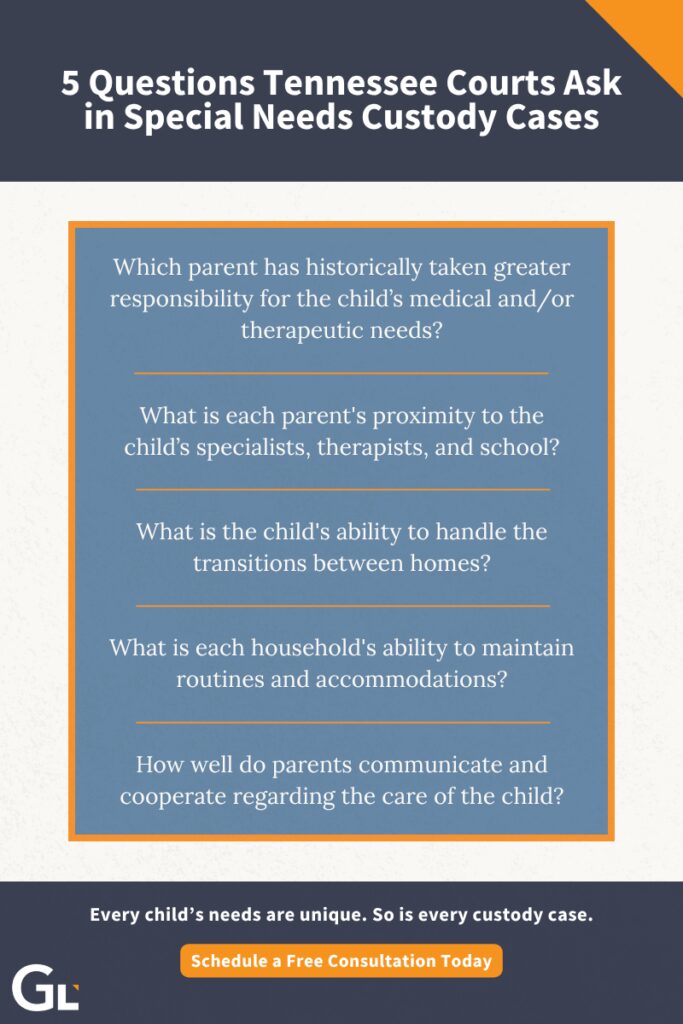
Key factors that tend to influence these decisions include:
- Each parent’s proximity to specialists, therapists, or the child’s school
- The child’s ability to handle transitions between homes
- Each household’s ability to maintain the child’s routine and accommodations
- Communication and cooperation between parents regarding care coordination
In some cases, a 50/50 split may not serve the child’s best interest. Courts may instead lean toward a primary residential parent having primary placement with a structured, predictable parenting time for the other parent. They may also include specific orders on educational services and medical treatment to address the unique needs of the child.
Raising a child with special needs requires that your child has their unique needs and concerns be addressed. Let us help you obtain a plan that serves the needs of your child.
Creating a Tennessee Parenting Plan for a Special Needs Child
A well-drafted Parenting Plan is one of the most important tools you have when co-parenting a child with special needs. A general template will not address the unique needs your child may have.
A strong Tennessee Parenting Plan for a child with special needs or disabilities should address:
- Decision-making authority for medical, therapeutic, and educational choices
- Communication requirements surrounding appointments, diagnoses, and school meetings
- Transportation logistics for therapy or other medical appointments
- What happens when the child’s needs change significantly
- Protocols for emergency medical decisions
The more specific and thoughtful the plan, the less room there is for conflict down the road, providing stability for your child. Courts appreciate detailed plans that reflect a real understanding of the child’s day-to-day life and needs, and this is critical for children who often thrive on routine and predictability.
When Custody Orders Need to be Modified
Needs and accommodations for a child with special needs may change over time. A child who needed one level of support at age five may need something very different at age twelve. Tennessee law allows parents to seek a modification to an existing custody order when there has been a material change in circumstances, and a significant shift in a child’s medical or developmental needs may qualify.
If your current arrangement is no longer working for your child, it may be time to revisit the order. This is especially true if:
- Your child has received a new diagnosis requiring additional assistance
- Therapy needs have increased
- One parent has relocated closer to or further from key providers
- The existing plan is causing the child stress or regression
Modifications are a potential option available to make sure your child’s needs are being addressed where they are now, versus where they were previously.
Your Child Deserves a Plan Built Around Their Needs. We Can Help.
At Gravis Law, we understand that no two families are the same, and no two children with special needs are either. Our attorneys work with parents throughout Tennessee, including families in the Knoxville, Blount, Loudon, and Monroe Counties, to build custody arrangements that truly reflect what their child needs to thrive.
Whether you’re starting from scratch or needing to modify an existing order, we’re here to guide you through the process with care and clarity. Schedule a consultation with us today and take the first step toward a Parenting Plan that works for your whole family.
About the Author
Katherine Sierra-Kelly is a Senior Family Law Attorney at Gravis Law – Knoxville, focusing on matters including custody, divorce, visitation for unmarried parents, and modification of existing custody orders. She has extensive experience as a Guardian ad Litem, representing children’s interests in custody proceedings across her career. Working with families that have special needs children is something Katherine truly enjoys as she believes these are the children whose voices are not always heard or understood in custody proceedings.
Katherine is passionate about advocating for families and children during some of life’s hardest moments, recognizing that no two situations are alike and that thoughtful legal guidance can shape a child’s future for the better.
This article is for informational purposes only and does not constitute legal advice.
Download our guides for expert insights to plan your estate, navigate family law, or secure your future. Simplify the process with clear, actionable steps. Get started today!