
Written by child support attorney Mary Kate Moss.
When one parent runs their own business, freelances, or earns income through side hustles, calculating child support becomes significantly more complicated than reviewing a pay stub. Courts still expect accurate, complete income reporting for child support self-employed parents, and the process of getting there requires a different approach than traditional W-2 cases.
Understanding how courts evaluate self-employment income can make a meaningful difference in what you pay or receive.
How Courts Calculate Income for a Self-Employed Parent
Child support calculations are based on income, but for self-employed individuals, determining what counts as income requires digging deeper than a tax return.
Courts generally look at gross business receipts minus legitimate business expenses to arrive at a net self-employment income figure. However, not every deduction that the IRS allows will be accepted by a family court. Judges have the authority to add back expenses they consider personal in nature or excessive, such as:
- Vehicle expenses that appear to blend personal and business use
- Meals, entertainment, and travel that benefit the individual more than the business
- Depreciation deductions that reduce taxable income but not actual cash flow
- Payments to family members that may not reflect real market-rate work
The result is that a parent’s court-calculated income can look quite different from what appears on their Schedule C or business tax return.
Child Support Side Hustle Income: What Counts and What Courts Look For
39% of working Americans report having a side hustle, and family courts are increasingly familiar with the reality that income does not always come from one source or employer. Gig income child support calculation has become a more common issue in family law proceedings as platforms like Uber, DoorDash, Etsy, and freelance marketplaces have become mainstream sources of income.
Courts treat side hustle income as countable income for child support purposes, regardless of whether it is reported consistently or arrives on a 1099. Relevant sources include:
- Freelance or contract work
- Rental income from property or short-term rentals
- Online sales, content creation, or affiliate income
- Gig platform earnings
- Cash-based work or informal services
If a parent is earning it, courts generally want to count it.
Income reporting is rarely as simple as it looks.
Calculating Income for Child Support When Earnings Are Inconsistent
One of the most contested issues in self-employed income child support modification cases is how to handle income that fluctuates month to month or year to year. Courts in Utah typically average income over a period of time, often two to three years, to arrive at a representative figure.
This is where documentation becomes critical. A parent seeking a fair calculation should be prepared to provide:
- Two to three years of personal and business tax returns
- Bank statements for all accounts, personal and business
- Profit and loss statements
- 1099 forms and invoices
- Records of cash transactions or informal income
If a self-employed parent cannot or does not provide adequate documentation, the court may impute income based on earning capacity, prior income history, or industry standards for someone with their skills and experience.
When a Parent Hides Income or Underreports Earnings
This is one of the most serious issues in child support cases involving self-employment. Because self-employed individuals have more control over how their income appears on paper, there is greater opportunity for underreporting.
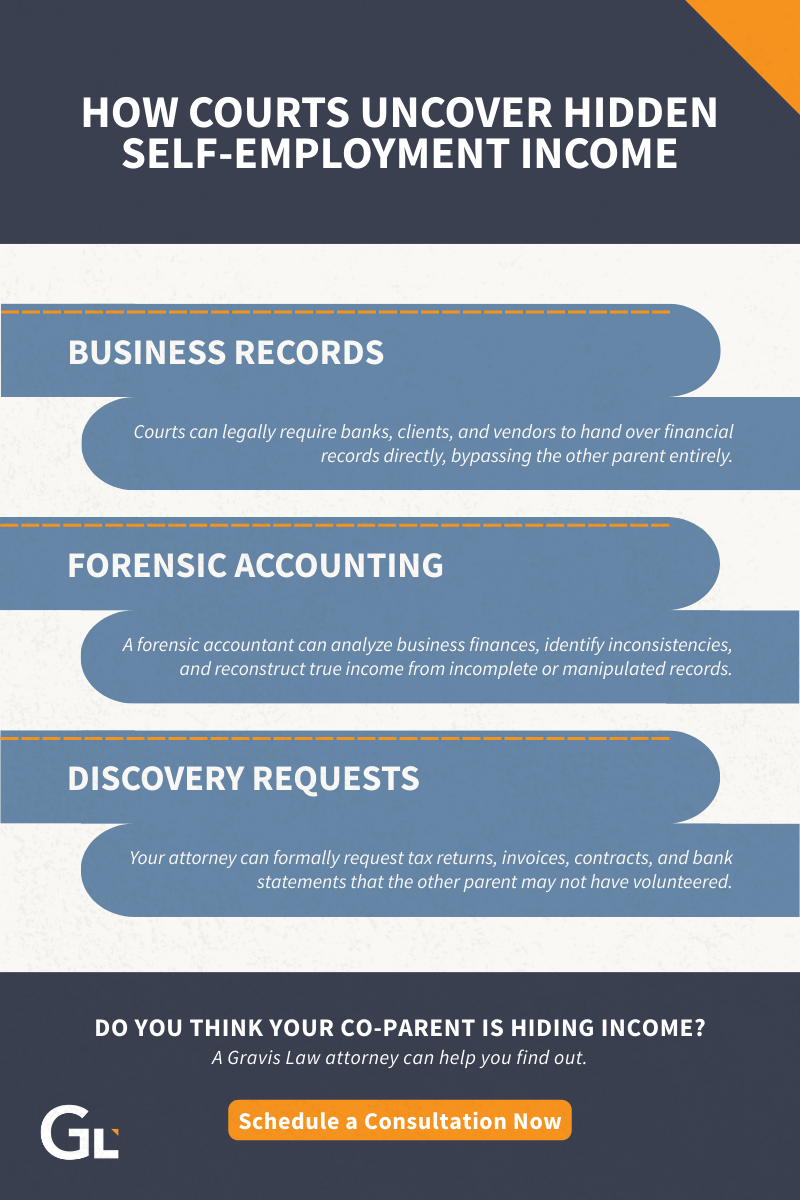
Courts and attorneys have tools to address this, including subpoenas for business records, forensic accounting, and discovery requests. If a pattern of underreporting is established, a judge can impute a higher income and may take the financial misconduct into account when making support determinations.
Parents in Orem, Utah, and the surrounding areas who suspect their co-parent is underreporting self-employment income have legal options available to them and should not navigate that process alone.
When the Numbers Do Not Add Up, We Can Help
Child support cases involving self-employment or side hustle income require careful documentation, a clear understanding of how Utah courts evaluate non-traditional earnings, and an attorney who knows how to build or challenge an income calculation.
Whether you are seeking a fair support order or a modification based on changed circumstances, the stakes are too high to guess.
Our family law attorneys in Orem and Salt Lake City, Utah, work with parents on both sides of self-employment income disputes and understand how to present or challenge financial evidence effectively.
If your child support situation involves complicated income, schedule a consultation now and get a clear picture of where you stand.
About the Author
Mary Kate Moss is a family law attorney and principal at Gravis Law who represents clients throughout Utah, with a focus on delivering results-driven service in even the most complex family law matters. She played a key role in opening and growing Gravis Law’s Utah offices, bringing accessible, high-quality family law services to clients in Orem, Salt Lake City, and beyond.
Mary Kate brings both strategic experience and personal commitment to child support cases, particularly those involving complicated financial circumstances. She tailors her approach to each client’s specific goals, working to minimize conflict where possible while advocating vigorously when the situation requires it.
Download our guides for expert insights to plan your estate, navigate family law, or secure your future. Simplify the process with clear, actionable steps. Get started today!