
Written by Jason Jenkins.
For parents of children with special needs, the 18th birthday is not just a milestone. It is a legal and financial turning point that can put SSI benefits at serious risk if you are not prepared. Understanding how SSI eligibility young adults face changes at 18 can mean the difference between continued support and unexpected loss of benefits your family depends on.
What Changes When Your Special Needs Child Turns 18
The Social Security Administration does not simply carry over childhood SSI eligibility into adulthood. At 18, the SSA conducts what is called a redetermination review, applying adult disability criteria rather than the childhood standard your child was originally approved under. This means your child must now meet the adult definition of disability, which is stricter and evaluated differently.
At the same time, the SSA shifts how it calculates financial eligibility. During childhood, parental income is factored into the equation. After 18, only your child’s own income and assets are considered. This sounds like good news, but it creates a new risk: any assets in your child’s name, including savings accounts, inheritances, or gifts, could disqualify them from receiving benefits.
How SSI Benefits Turning 18 Can Be Affected by Assets and Income
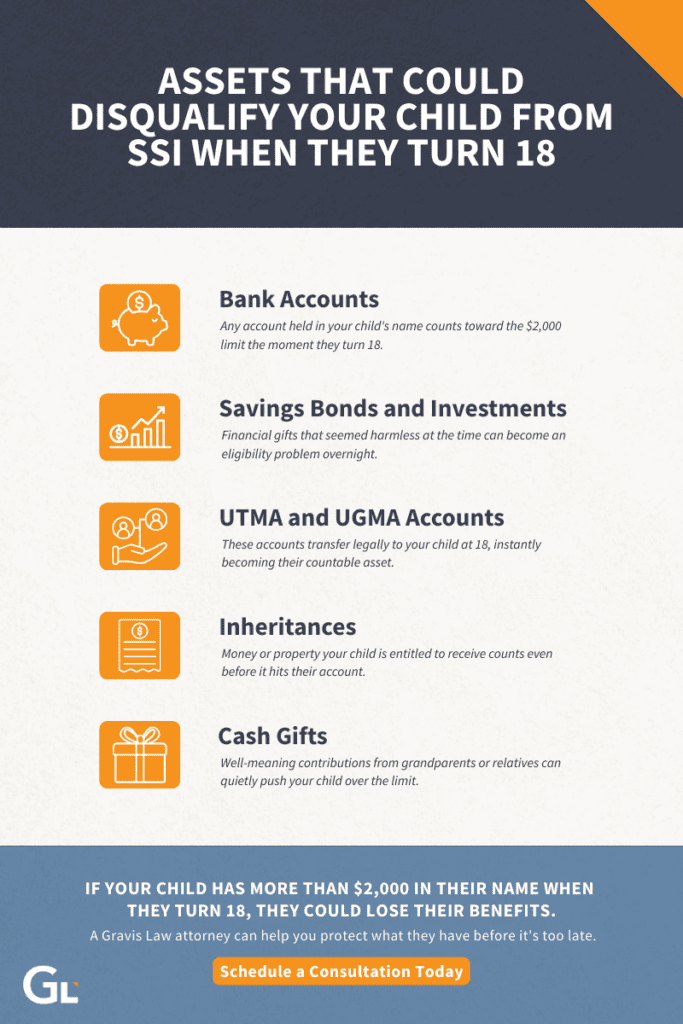
SSI has strict asset limits. As of 2024, an individual cannot have more than $2,000 in countable assets and remain eligible. If your child has money in their name, whether from a savings account you set up years ago or a well-meaning gift from a grandparent, it may count against them.
This is one of the most common and preventable reasons families lose SSI benefits turning 18. A few things to review before your child’s 18th birthday:
- Any bank accounts held in your child’s name
- Savings bonds or investment accounts gifted to them
- Inheritances they may be entitled to receive
- UTMA or UGMA accounts transferred at 18
One tool families often overlook before this transition is the ABLE account.
What Are ABLE (Achieving a Better Life Experience) Accounts?
An ABLE account is a tax-advantaged savings and investment option for people with disabilities whose disability began before age 46. Funds in an ABLE account can be used for qualified disability expenses (QDEs) and do not count as income when used for those purposes. Investment earnings grow tax-free and generally do not affect eligibility for most needs-based federal benefits.
Many public benefit programs limit eligibility to individuals with less than $2,000 in countable resources, putting critical benefits at risk if savings exceed that amount. Up to $100,000 in an ABLE account is excluded from countable resources for Supplemental Security Income (SSI), and balances up to the state plan limit do not affect eligibility for programs such as Medicaid, SNAP, HUD, FAFSA, SSDI, Medicare, or vocational rehabilitation.
ABLE funds may be used for a wide range of expenses, including housing, food, transportation, education, employment, and medical costs. The ABLE National Resource Center is a good starting point for comparing state plans and understanding contribution limits.
Special needs planning is one of the most effective tools for addressing this issue before it becomes a crisis.
Is your family approaching this milestone?
What Is a Special Needs Trust and How Can It Protect Benefits?
A special needs trust planning strategy is one of the most important steps a family can take before their child turns 18. A properly structured special needs trust allows assets to be held for your child’s benefit without counting toward the SSI asset limit. This means family members can contribute financially to your child’s quality of life without jeopardizing their eligibility for government benefits.
There are two primary types to understand:
- First-party special needs trusts, funded with the individual’s own assets such as a personal injury settlement
- Third-party special needs trusts, funded by parents, grandparents, or other family members
Both serve important purposes, and the right structure depends on your family’s specific situation. Working with an attorney who understands estate planning and special needs law is essential to getting this right.
Guardianship for a Special Needs Adult Child: What Parents Need to Know
Many parents are surprised to learn that when their child turns 18, they no longer have automatic legal authority to make medical, financial, or legal decisions on their behalf. Even if your child has significant cognitive or developmental disabilities, the law considers them a legal adult.
Guardianship for a special needs adult child gives a parent or caregiver the court-authorized ability to continue making decisions in their child’s best interest. Depending on your child’s level of independence, a full or limited guardianship may be appropriate.
It is worth noting that guardianship is not the only option. Lesser restrictive alternatives such as supported decision-making agreements or a durable power of attorney may be sufficient in some cases. An attorney familiar with both Social Security Disability and special needs planning can help you evaluate which path makes sense.
Families in Washington State working through these decisions can find support at Gravis Law offices across the state, including Spokane, Richland, Tacoma, Olympia, Seattle, Dayton, and Kennewick.
Gravis Law Is Here When the Path Forward Feels Unclear
The transition to adulthood for a child with special needs involves more moving pieces than most families expect, and the stakes are high. From protecting SSI eligibility to establishing guardianship and building a trust that works, these decisions deserve careful, experienced guidance.
Our special needs planning attorneys work with families across Washington State, with deep roots in Spokane and offices throughout the region, to help you plan with confidence rather than scramble after a benefit is lost.
Reach out to us today to schedule a consultation and make sure your child’s 18th birthday is a milestone you are ready for.
About the Author
Jason Jenkins is a disability law attorney at Gravis Law with seven years of experience representing Social Security disability claimants and a personal commitment to advocating for individuals with special needs.
A member of both NOSSCR and NADR, Jason brings practical, firsthand knowledge of SSA processes to every family he works with.
Download our guides for expert insights to plan your estate, navigate family law, or secure your future. Simplify the process with clear, actionable steps. Get started today!